
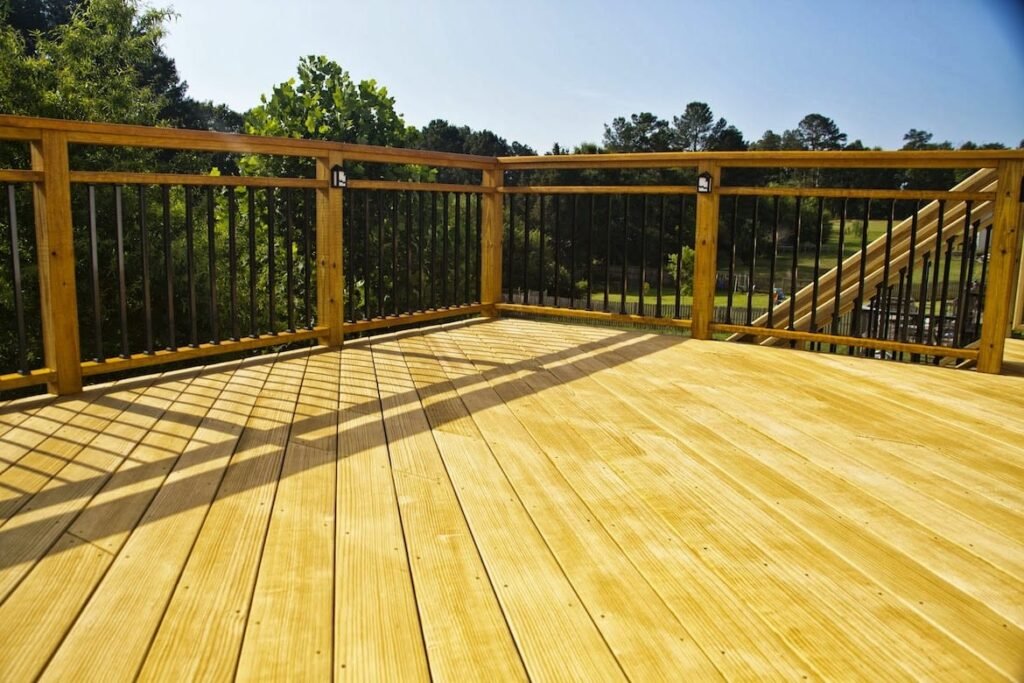
The challenges of achieving fire resistance for exterior wood decks include the inherent combustibility of wood, the limitations and maintenance requirements of chemical treatments, and the practical difficulties associated with naturally fire-resistant alternative materials.
Inherent Material Vulnerabilities
• Combustibility: A fundamental challenge is the natural composition of wood, which is described as “light” with “lots of air inside,” making it generally not fire-resistant.
• Combustion Mechanism: When wood burns, heat turns the solids into vapor, which then combusts as flame. Surface coatings often fail because they crack as this vapor attempts to escape.
• Penetration Issues: Skepticism exists regarding the ability of finishes to meaningfully change redwood’s flammability, with some suggesting that effective fire resistance would require the material to be soaked or multiple spray applications rather than just coated with a single pass.
Limitations of Fire-Retardant Treatments
• Weathering and Leaching: Exterior treatments are susceptible to environmental exposure. For products like Flamex PF-2, the lifespan of the treatment is eventually shortened by rainfall and UV rays, as it is a leach-resistant but ultimately a water-based solution.
• Maintenance Requirements: Fire resistance is not a one-time “paint on and leave” solution. Treatments require regular reapplication, recommended between every 2 to 5 years depending on local rainfall.
• Application Constraints: Applying fire barrier sprays requires strict conditions, such as specific temperature minimums (50°F+), a clean and porous surface, and a window of 48 hours without rain,.
Challenges with Fire-Resistant Timber Alternatives
• Workability and Cost: While dense woods like Ipe or engineered bamboo products (like Mosso) offer high fire resistance (some are described as “totally fireproof” or “basically don’t burn”), they are significantly more expensive and difficult to cut compared to standard lumber.
• Availability: The supply of naturally fire-resistant hardwoods like Ipe has become scarce or “burned itself out” as a market option in some areas.
Structural and Environmental Risks
• The “Kindling” Effect: Even if the house is hardened, decks are often the first structure to ignite during wildfires, effectively acting as kindling that spreads fire to the main residence.
• External Ignition Sources: Fire resistance is compromised by the environment surrounding the deck. Accumulated weeds, brush, and flying hot ash/embers are primary ignition vectors, meaning a fire-resistant deck may still be vulnerable if the surrounding area is not maintained.