Passive vs. Active Fire Protection: Key Differences
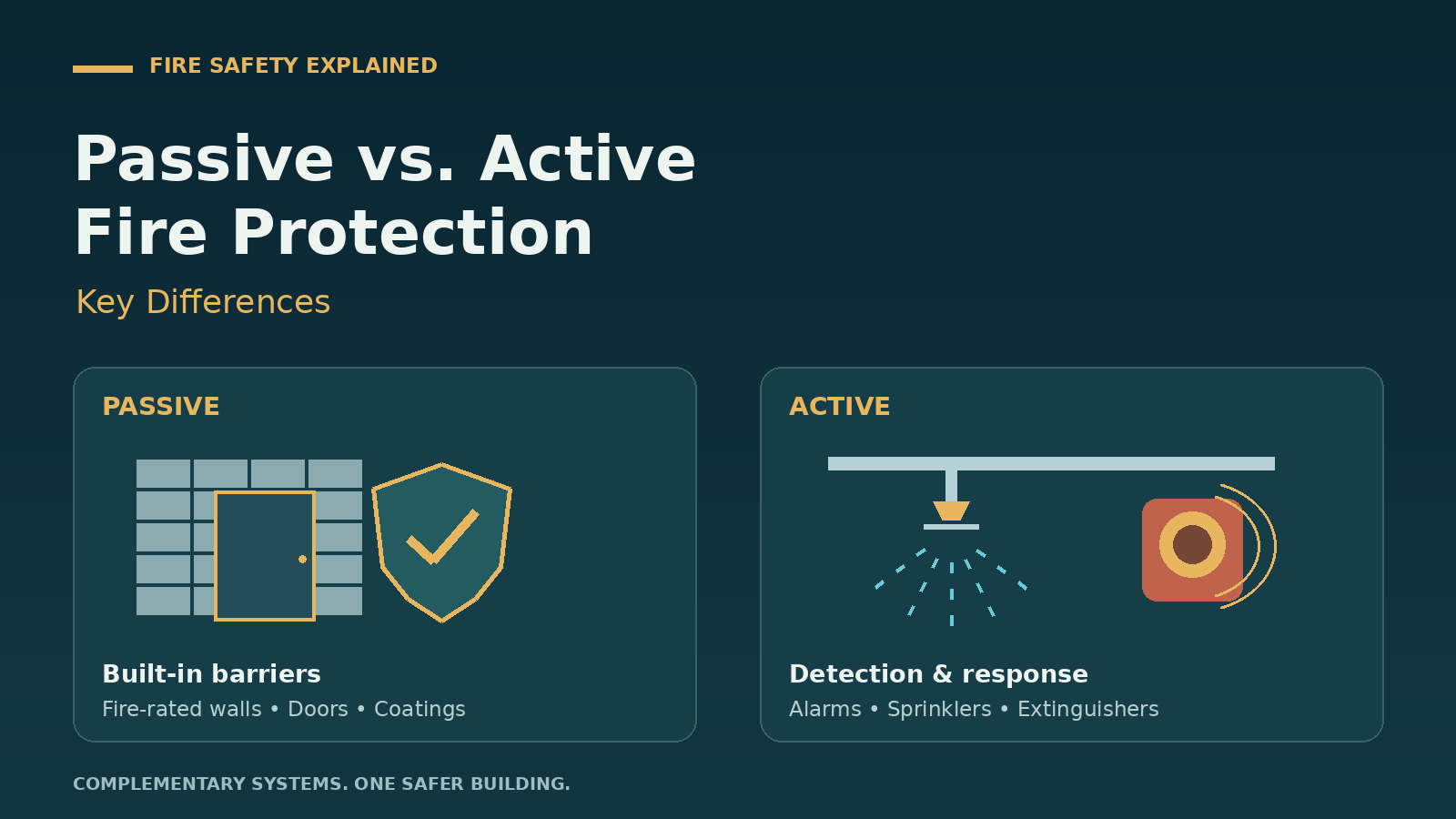
Passive fire protection limits fire spread and delays heat damage to structural components. Active fire protection detects a fire, warns occupants, or controls and suppresses it through automatic or manual operation. Buildings typically need both as part of a coordinated fire-safety strategy.
The terms passive fireproofing and active fireproofing are sometimes used interchangeably with fire protection. However, fireproofing usually refers more specifically to protective materials applied to structural members. No treatment makes an entire building immune to fire.
What Is Passive Fire Protection?
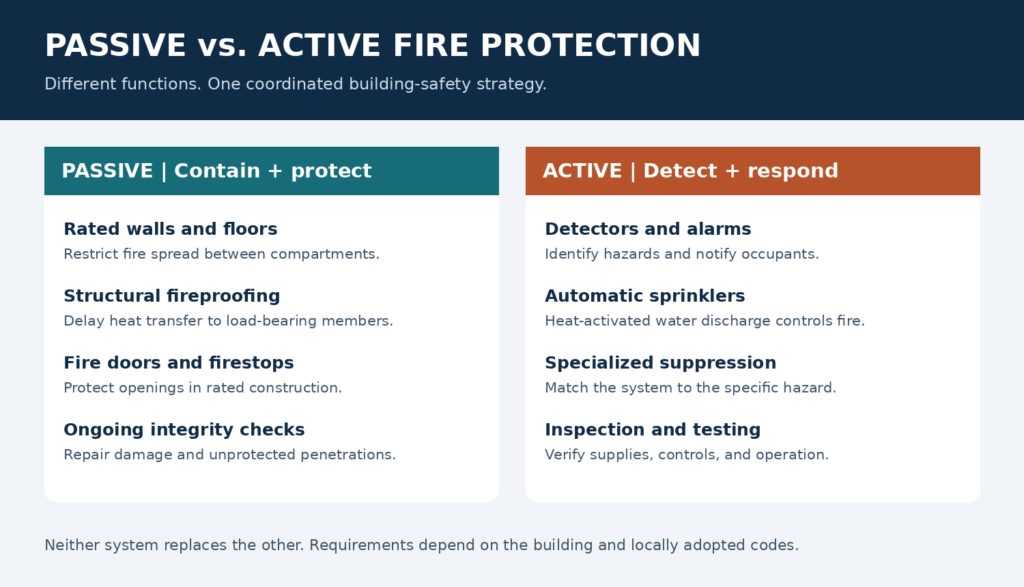
Passive fire protection (PFP) consists of built-in materials and assemblies that help contain fire, restrict smoke movement where designed to do so, and preserve structural capacity during fire exposure. Its primary purpose is to manage the consequences of a fire—not prevent ignition or extinguish flames.
Many passive measures work without electricity or human intervention. Some components, including fire doors and dampers, must close or change position to perform their protective function. The distinction is therefore more nuanced than “passive systems never move.”
Structural Fireproofing and Fire-Resistant Coatings
Spray-applied fire-resistive materials, intumescent coatings, board systems, and appropriate concrete encasement can delay heat transfer to structural members. Intumescent coatings expand under heat to form an insulating char. Their performance depends on the tested design, substrate, application thickness, and installation conditions.
Steel is noncombustible but can lose strength and stiffness at elevated temperatures. Concrete performance also depends on design and exposure. Neither material should be assumed to provide unlimited protection simply because it does not readily burn.
Fire-Rated Walls, Floors, and Compartments
Fire-resistance-rated walls and floors divide a building into compartments to help limit fire spread. A rating belongs to the complete assembly, including its construction details and opening protection—not just one board or material. Fire walls are a specific code-defined assembly, not a generic name for every rated partition.
Fire Doors, Glazing, and Dampers
Properly selected fire doors, fire-rated glazing, and dampers protect openings in barriers. Fire doors must close and latch as required; wedging them open can defeat their purpose. An alarm-controlled hold-open device illustrates how active controls can support a passive barrier. Smoke protection depends on the applicable assembly and leakage requirements.
Firestop Systems for Penetrations and Joints
Tested firestop systems protect service penetrations and joints in rated construction. Selection must match the wall or floor, penetrating item, opening dimensions, backing materials, and sealant depth. Ordinary caulk or expanding foam is not a substitute for an appropriate tested system.
Benefits and Limitations of Passive Protection
Passive measures provide built-in protection, support protected escape routes, and can help reduce fire spread and structural damage. They do not normally extinguish a fire, and their performance is limited by the tested design and actual exposure. Damage, missing firestops, incompatible alterations, or deteriorated coatings can compromise them. Passive protection is not maintenance-free.
What Is Active Fire Protection?
Active fire protection (AFP) uses systems or equipment that operate in response to a fire or its warning signs. Operation may be automatic, such as a heat-activated sprinkler, or manual, such as a trained person using an extinguisher. Some systems detect and communicate danger; others control fire or manage smoke.
Fire Detection and Alarm Systems
Smoke detectors, heat detectors, manual alarm stations, and notification appliances help identify and communicate an emergency. An alarm does not itself extinguish a fire. Notification to emergency services depends on the monitoring arrangement; do not assume every building alarm automatically calls the fire department.
Automatic Fire Sprinklers
In typical closed-head sprinkler systems, individual sprinklers open when their heat-sensitive elements reach their operating temperature. Smoke alone does not activate these sprinklers, and one operating head does not normally cause every head to discharge. Deluge and other specialized systems operate differently.
Sprinkler reliability depends on suitable design, an adequate water supply, open control valves, and ongoing maintenance. Not every sprinkler system requires electrical power at the sprinkler head, although pumps, monitoring, or other associated equipment may need power.
Portable Extinguishers and Specialized Suppression
Portable extinguishers must be suitable for the anticipated fire class. Only people trained and authorized under the applicable emergency plan should consider tackling a small, incipient-stage fire, with a clear escape route and without delaying evacuation or emergency notification.
Specialized protection can include wet-chemical systems for commercial cooking hazards, clean-agent systems for certain sensitive spaces, or foam systems for appropriate flammable-liquid hazards. Selection depends on the hazard, occupancy, equipment compatibility, and applicable requirements—not simply a preference to avoid water.
Smoke-Control Systems
Where required, engineered smoke-control systems use measures such as exhaust or pressurization to manage smoke movement. They do not prevent all smoke or toxic-gas production and must be coordinated with the building’s barriers, controls, and emergency power arrangements.
Benefits and Limitations of Active Protection
Active systems can provide early warning and rapid fire control. Their reliability depends on appropriate design, functioning components, required supplies, and inspection, testing, and maintenance. Alarms, sprinklers, and suppression systems perform different tasks; none replaces all other life-safety measures.
Passive vs. Active Fire Protection: Comparison
| Feature | Passive fire protection | Active fire protection |
|---|---|---|
| Primary role | Contain fire; protect structural members and openings | Detect, alert, control, suppress, or manage smoke |
| Examples | Rated assemblies, firestops, structural coatings, fire doors | Alarms, sprinklers, extinguishers, suppression systems |
| Operation | Often inherent; some components must close | Requires automatic activation or manual operation |
| Dependencies | Assembly integrity, compatible materials, proper installation | System-specific water, power, controls, agents, or manual action |
| Maintenance | Inspection and repair of barriers, doors, seals, and protection | Scheduled inspection, testing, servicing, and impairment management |
| Main limitation | Does not normally extinguish fire | Does not replace required structural protection or compartmentation |
Installation time, cost, and protection duration cannot be ranked reliably as simply “long” versus “short.” They depend on the system, building, access, required performance, and project conditions.
Why Buildings Need Both Passive and Active Protection
Consider a fire in a storage room. Detection may alert occupants, sprinklers may control burning, and rated walls and a closed fire door may help limit spread. Structural fireproofing can delay heat damage to protected members while occupants evacuate and firefighters respond.
These layers address different failure pathways. A sprinkler does not seal an unprotected wall penetration, and a rated wall does not provide an evacuation alarm. Combining them improves resilience, but does not guarantee that fire damage or injuries cannot occur.
How to Choose the Right Fire Protection Strategy
The decision is not usually passive versus active. It is which combination meets the building’s hazards and applicable requirements. Work with qualified design professionals and the authority having jurisdiction to evaluate:
• Occupancy and evacuation needs, including sleeping occupants and people who need assistance.
• Building height, area, construction type, and required fire-resistance ratings.
• Fuel loads and special hazards, including cooking, storage, industrial processes, and equipment.
• Water supplies, power arrangements, monitoring, and system interfaces.
• Access for inspection, maintenance, repair, and future alterations.
• Locally adopted codes, applicable standards, and approved project documents.
Assess lifecycle costs rather than installation price alone. Include testing, servicing, repairs, recoating where needed, and management of system outages. A perceived low likelihood of fire is not a reason to omit required protection.
Inspection and Maintenance: Keeping Both Systems Effective
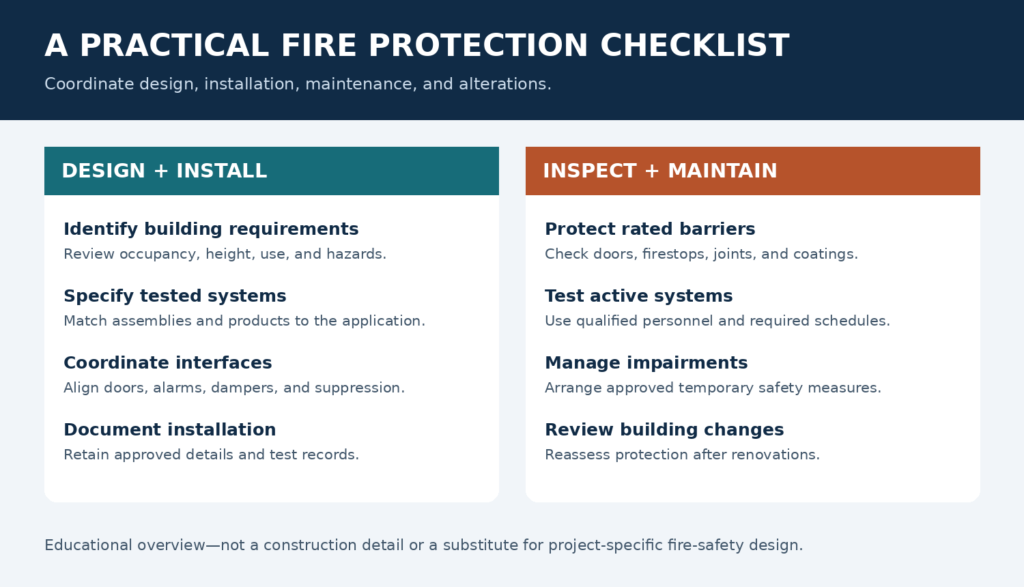
Create a documented program with qualified personnel. Verify that fire doors operate correctly, firestops remain intact, and structural coatings are not damaged. Check active-system components, supplies, signals, and controls at the applicable intervals. Reassess protection after renovations or changes in building use.
Common U.S. references include NFPA 25 for water-based system inspection, testing, and maintenance; NFPA 72 for fire alarm and signaling systems; NFPA 80 for fire doors and other opening protectives; and NFPA 10 for portable extinguishers. NFPA 4 addresses integrated testing of fire protection and life-safety systems. Use the editions and provisions applicable to the project rather than assuming one universal inspection schedule.
Frequently Asked Questions
Is passive fire protection better than active fire protection?
Neither is a universal replacement for the other. Passive systems support containment and structural protection, while active systems provide warning, control, or suppression. The required combination depends on the building.
Are fire doors passive or active fire protection?
Fire door assemblies are generally considered passive protection because they protect openings in barriers. Their closers, hold-open releases, and alarm interfaces may involve mechanical or active functions.
Does passive fireproofing need maintenance?
Yes. Coatings, rated barriers, firestops, doors, and dampers need appropriate inspection and repair. Renovations and service installations can create defects that are not immediately visible.
Is a Class A flame-spread rating the same as an hourly fire-resistance rating?
No. A surface-burning classification addresses different performance from an assembly’s hourly fire-resistance rating. One does not automatically establish the other.
Can sprinklers replace structural fireproofing?
Not as a general rule. Some adopted codes permit specific design allowances, but any reduction or substitution must be explicitly allowed and incorporated into an approved design.
Build a Coordinated Fire-Safety Plan
Effective building fire safety combines passive protection, active systems, safe evacuation arrangements, and ongoing management. Start with a professional review of the building’s requirements, then address installation quality, system coordination, and maintenance throughout its service life.
This article is an educational overview, not a project-specific code determination or an installation guide.
References and Further Reading
Interface Engineering — Balancing Passive, Active Fire Protection: https://www.interfaceengineering.com/news-and-awards/balancing-passive-active-fire-protection
NIST — Inspection, Testing, and Maintenance of Fire Protection and Life Safety Systems: https://www.nist.gov/system/files/documents/2023/08/24/NIST%20S%207401-02_ITM%20of%20Fire%20Protection%20and%20Life%20Safety%20Systems_042221.pdf
Applicable NFPA standards: NFPA 10, NFPA 25, NFPA 72, NFPA 80, and NFPA 4. Confirm adopted editions and local amendments with the authority having jurisdiction.