Fire Retardant Coatings: A Practical Guide to Protecting Your Business
If you are a business owner or manage buildings or other facilities, you will want to take every reasonable step to safeguard your good name. That will include measures to protect your employees, visitors, assets and business processes.
Obvious provisions such as smoke detection and fire alarm systems form just one element of overall protection against the effects of fire. Various other methods can limit the rate of spread of fire, or provide some measure of protection to building elements. Fire retardants and fire-resistive coatings fall into this category.
Obviously none will guarantee that a material will not ignite in all circumstances and none “fireproof” a combustible. However, used appropriately, many can be valuable adjuncts to other life safety systems, including automatic sprinklers, and assist in meeting various code provisions.
The purpose of this information is to describe generally the action of various types of fire retardants, some typical uses and a few points to bear in mind when considering purchase.
How do Fire Retardants function?
Various chemicals can be used to modify the rate of burning and other characteristics when a material is subjected to fire. They may act to retard burning, reduce evolved gases, or insulate, or some combination of these.
Several principles may apply:
1. Promotion of char formation
Many treatments react with wood or other materials, to promote a relatively thick char which acts as an insulator and reduces rates of evolution of combustible products.
A range of intumescent paints also acts primarily to insulate, forming a much increased thickness of char upon exposure to fire. The degree of expansion will vary with the particular product, base material, thickness of application, severity and duration of exposure, and other variables.
2. Absorption of heat
Aluminum trihydrate and magnesium hydroxide will absorb considerable quantities of heat during decomposition, with evolution of steam. Thus they tend to lower the temperature of the surrounding material and dilute evolved gases. They find various uses, including in plastic and composite materials.
3. Effects on evolved gases
Certain chemicals can have an inhibiting effect on some of the reactions involved in combustion. Others can evolve non-combustible gases, diluting combustibles evolved at or near the surface. Either or both principles may apply to any particular product, and other characteristics, including environmental effects, will depend on all of the ingredients. So it is meaningless to generalize on the basis of whether halogenated or not.
Uses
Obviously many considerations enter into selection of a suitable product for any given application, including the base material to be protected. For example, products to be applied to draperies would generally have very little applicability to structural steel.
Draperies, other hangings and similar materials
Hotels, auditoriums, schools, churches and many other assembly occupancies.
Many materials used for decoration may be required to satisfy prescribed limits on the rate of spread of flame. One frequently applicable test for a wide variety of materials, including some films, is NFPA 701. Of course, other requirements may apply, depending on jurisdiction, type and use of material.
Flamex PF and similar products could be applicable to many fabrics. In all cases it would be desirable to know that the manufacturer recommends and has information applicable to the particular material.
Points to consider include:
Type and proportion of various fibers;
Effect of dyes, backing or other treatments on uptake of the solution;
Rate of application recommended by manufacturer (it would be misleading to apply based on an assumed sq ft per gallon);
Desirable to try a hidden area for effect on color, hand and other characteristics;
Frequency of washing, dry-cleaning or other soaking.
Various requirements may apply to other soft goods such as upholstered seating. A drapery would not necessarily be indicative of the response of all components of such an article.
Wood and other interior surfaces
Common settings: Shops, hotels, offices, auditoriums and other occupancies, and remodels.
Spread of flame over the surface can be limited, using one or more methods. A penetrant may be applied, or various intumescent paints used.
In general, penetrants are applicable to bare, readily absorbable surfaces. A range of finishes may be used over some intumescent products, subject to appropriate preparation, primers, top coatings and so on, consistent with the manufacturer’s data for that system.
Each product, such as Flamex PF-1 and Flamex PF-2 or the range of Contego products, would need to be judged on the basis of information applicable to each product.
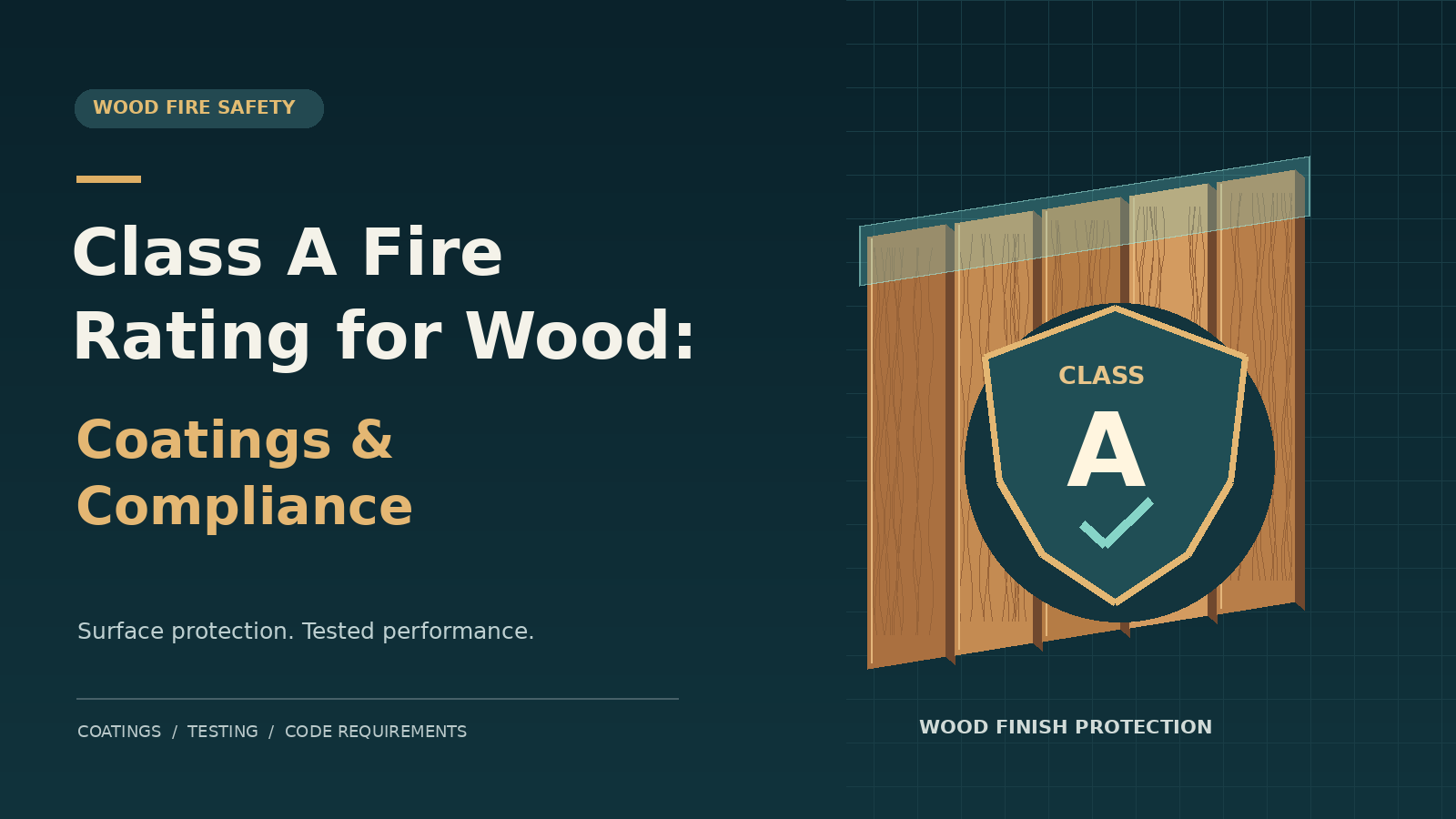
A critical distinction: It would be important to appreciate that a “Class A” classification would not preclude ignition and burning, nor imply any number of hours of fire resistance, nor necessarily fulfill requirements for “fire retardant treated wood”.
Exposed Structural Steel
All types of buildings, factories and other industrial uses.
Steel will of course not ignite, but it may soften, lose strength and deflect as temperatures are raised. Various intumescents can be applied which will greatly increase in thickness under heat and so tend to slow heating of the steel. Contego High Solids and similar products are available. They would be used in conjunction with an approved design. There is no inherent 1- or 2-hour quality about any one paint. Number of hours protected will depend on section or sections of metal involved, period of resistance desired, design used, thickness of coating, primers and finishes, if any, method and quality of application and subsequent inspection. It is possible that fewer applications may be required to achieve a given thickness, but time saving would depend on maximum thickness practicable per coat, curing times, et cetera.
Applicable standards
Many tests may be relevant, and it would be important to obtain reports applicable to the material and degree of protection desired. It would be quite meaningless to know only that some item had been “fire tested”.
NFPA 701
NFPA 701 describes several methods of testing the rate of flame spread of various textiles and some other materials, such as films. As above, applicable test and limits desired would need to be established for any drapery or similar material. There is no reason to assume equivalent performance on other weights, finishes and combinations of fibers.
ASTM E84
ASTM E84 is a test standard used to determine the Flame Spread Index and Smoke Developed Index of building materials. Building codes often prescribe maximum values for these indices based on the material classification. The maximum values typically associated with Class A are:
Flame Spread 0 to 25
Smoke Developed 450 or less.
Again this would pertain only to the particular item or items and conditions tested. It gives no indication of hours of fire resistance.
ASTM E2768
This uses a larger tunnel and subjects the specimen to a 30-minute test, again determining rates of flame spread and smoke developed, among other characteristics. It may be applicable to some uses of FRTT and other situations. It should not be interpreted as testing only susceptibility to re-ignition, nor that satisfying this test would fulfill all criteria which may apply to a given wood use.
Structural protection
Where hours of resistance are required, appropriate designs or assemblies, typically to ASTM E119 or UL 263, would need to be established. It would be prudent to establish what documentation was desired, via the designer, building department, fire marshal or others with interest or jurisdiction.
Advantages to a commercial concern
There are clearly many variables, and only the individual situation could determine what benefit, if any, might be derived. Nevertheless, some general comments may be useful.
Life safety; property protection
As discussed above, there are various ways in which spread of flame, and rate of heating of structural and other members, may be reduced. None would be a substitute for proper installation and maintenance of electrical and other equipment, good housekeeping, prudent evacuation procedures and other appropriate fixed systems.
Retrofit
It may be possible, subject to approval, to leave certain existing conditions in place, with consequent saving of expense, inconvenience and loss of desirable features. However, it should be emphasized that there may be requirements for particular types or ratings of construction, which could not simply be “coated over”.
Cost
Many other costs in addition to cost per gallon should be considered when comparing products and methods, such as preparation of surface, primers and finishes, rates of application and total thickness, skill and cost of labour, special equipment, time to cure, inspection, future maintenance, and so on. It could well prove less expensive overall to purchase a more costly product per gallon.
Other considerations
Many users give considerable thought to environmental aspects. However, it would be dangerous to draw conclusions simply from a description such as “green”, “non-toxic”, “water-based” and the like. It would be prudent to obtain and review current SDS, notes re application, including ventilation, other precautions, information on VOC content and other emissions, limitations re presence of personnel, effects on and disposal to the environment, and any third-party endorsements. Clearly there may be desirable features to some non-halogenated products, some of which may be derived from renewable resources. However, it would not follow that they would all be essentially non-toxic. Certification as to indoor air quality obviously would not speak to their effectiveness. Under no circumstances should any product be considered to produce acceptable, non-toxic smoke in the event of fire.
Summary of information to establish
To assist in selecting appropriate products and avoiding errors and unnecessary expense, consider:
Type of material to be coated
For fabric: all components, weave, backing and other finishes. Some man-made products may call for special treatment, or may be inappropriate.
Wood: type, bare or finished in any way. Finishes may preclude adequate penetration, or adhesion.
Metal: appropriate design for member or members and desired period.
Degree of protection desired
For example, rate of flame spread for soft goods; Class of finish; or number of hours to protect construction. Clearly different tests and criteria apply.
Environment and other exposures
Will remain in normal dry interior location? Subject to high humidity or periodic wetting? Exposed to weather? Washed? Subject to rubbing or other mechanical damage? It would not be prudent to expose an interior product to weather. Various requirements may apply to buildings in wild-land areas, which would need to be checked. It may not suffice merely to show a limited rate of flame spread.
Relevant data
Appropriate TDS, SDS, application data and test reports and listings should all be requested, and checked as to applicability to material to be coated, rates and thickness of coating, and environment. Note in particular that reference to a test, such as “to ASTM E84”, tells only what test was used, not results obtained.
Inspection, maintenance
Obvious good practice to retain information re type of product, date and extent of application, applicator, et cetera. Establish appropriate future inspections, retreatment and so on, as applicable.
Some questions which may arise:
Suitable for application in buildings occupied at time of application?
Some are so listed as applicable, subject to various conditions. Careful review of SDS and adherence to requirements re ventilation, precautions, curing times, et cetera would all be warranted. No assumption should be made that “water-based” is in any sense innocuous, or that products will inhibit production of harmful fumes.
Washability?
Varies considerably. Various degrees of washing and other soaking may be expected to degrade the treatment to varying degrees, possibly completely. Manufacturer’s recommendations should be followed, and subsequent testing considered.
Shelf life?
Various periods and conditions of storage will apply. After application, many variables, such as type and porosity of surface, environment, degree and type of cleaning, abuse, et cetera, will affect duration of effectiveness. There is no general rule as to, for example, re-application annually.
Will draperies or other materials be discoloured, et cetera?
Many products purport to leave little or no change, but many variables will affect this. Some change of colour, deposit, hand, sheen and other characteristics may occur. Trial of a sample would be strongly advisable.
Will “Class A” ensure no ignition?
Clearly not, as explained above.
Can steel be protected for, say, 2 hours, irrespective of type?
No. Many variables are involved in establishing any given period, as explained. An appropriate system would therefore need to be chosen for each situation.
Conclusion
There are many products available to provide various degrees of fire protection, and they may be very appropriate to many situations. It would be desirable first to establish the degree of protection required, choose suitable products, apply correctly, and be able to document these facts, rather than rely on generalisations as to “fireproofing”. This may be as simple as treatment of draperies or other decoration, or as significant as selection of appropriate system to protect steel. It would be prudent to seek information and concurrence from others having responsibility for approving such measures.
To discuss product options and request application-specific documentation, contact National Fireproofing Supply Co. at (219) 926-1477.